
Intermediate 1: The BodyGraph | Centers, Channels, and Gates
Decode BodyGraph mechanics to understand energy, relationships, and life
Purchase is processed securely via Jovian Archive
When you buy through this page, you also support the ongoing creation of deep Human Design resources on IConnectSmart – at no extra cost.
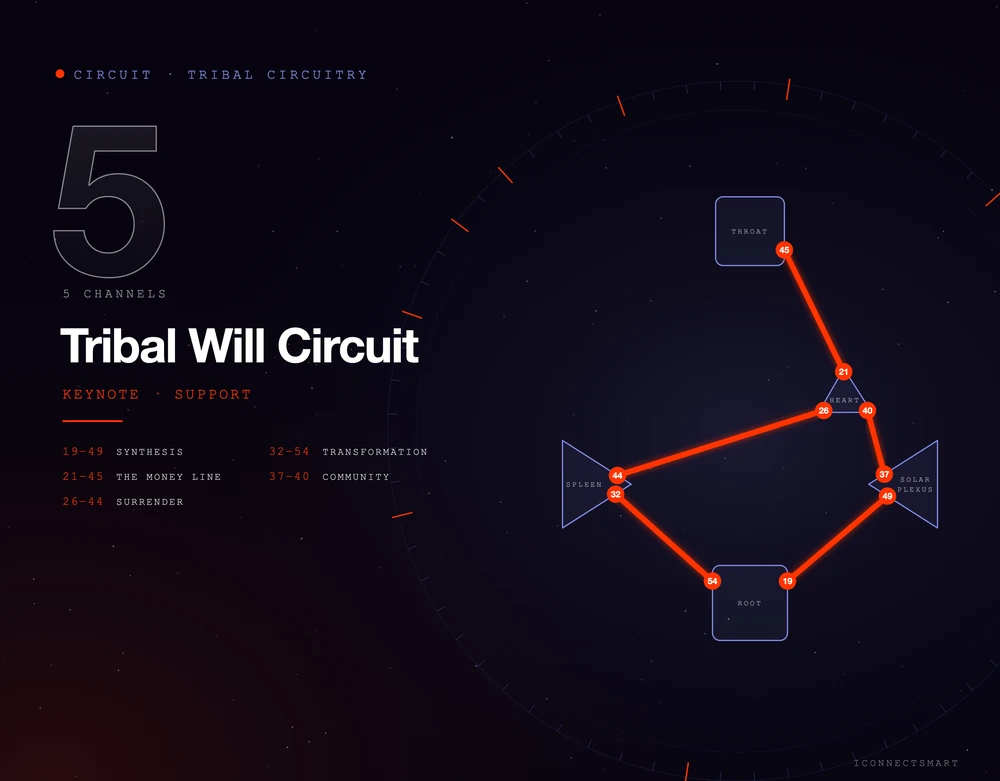
What Is the Tribal Will Circuit?

You have probably given something to someone, time, effort, real loyalty, and felt something in you quietly keeping score, even while you were consciously telling yourself it was unconditional. And you have probably felt guilty about that scorekeeping, as if it made the giving less pure.
It does not. It means you are carrying a very old, very honest kind of intelligence, one built entirely around the plain fact that support was never meant to run in one direction.
This deserves to be understood on its own terms, because it explains a whole category of relationships that can otherwise feel confusing or even a little mercenary from the outside, when they are simply working correctly.
Start with the basic emotional engine underneath this whole system, because it explains a pattern of build-and-release that can feel chaotic if you do not know its shape. Tension here does not stay level. It ratchets, climbing steadily, often through small, physical, easily missed moments, until it finally hits a threshold and releases in one clear burst, resetting the whole cycle back to baseline.
If you have ever watched a relationship or a working partnership build quiet pressure for weeks and then finally clear the air in one honest conversation, that was this mechanism completing its natural cycle, and nothing about it was dysfunction.
Underneath everything else in this system sits a single, unglamorous truth, and pretending otherwise tends to cause more damage than admitting it. Every real bond here runs on a bargain. Loyalty gets offered, and loyalty gets expected in return, and dressing that exchange up as something purely selfless usually makes the eventual resentment worse when the exchange stops being honored.
Cynicism has nothing to do with this. It is honesty about how tribal-level support has always worked, underneath whatever nicer language gets used to describe it.
From that foundation, several distinct pieces handle different parts of turning basic need into functioning material stability.
Resources, value and ambition
Start with the piece responsible for resource management, because it is the most directly commercial of the group. One half of this pairing speaks for the group’s overall position, what is available, what is not, the big-picture “we have” or “we don’t.” The other half controls the day-to-day decisions about how those resources get used, exercising real willpower over the operational details.
Someone carrying this well is doing more than protecting their own interests. They are using control to serve and support the people depending on them, and the two roles work best when they are clearly separated instead of collapsed into one person trying to do both jobs badly.
If this is yours, wielding real control over resources is not inherently selfish, whatever discomfort you might feel about it. Used correctly, it is what lets a group function and grow instead of drifting without direction.
Right alongside resource management sits a piece built for something more instinctive: the selling of value, the framing of what a group needs. This piece runs on a kind of nose for the situation, an instinctive read on what will serve the tribe’s survival, paired with a real skill at packaging that read into something persuasive enough to be believed and acted on.
To be honest about what this is: a valuable form of enterprise, not manipulation, as long as it stays anchored in a read of real need instead of being deployed purely for personal gain.
If you have this piece running in you, it comes with a built-in warning system, an instinctive sense of when something does not smell right. Ignore that internal alarm to chase a sale or a pitch that does not serve the people receiving it, and the whole mechanism stops working the way it is supposed to. Trust the smell test as much as the persuasive instinct, because both are part of the same design.
One piece is built purely around ambition, and it explains a specific, steady kind of drive that has nothing to do with flash or speed. This is consistent, patient effort, aimed at rising and improving one’s position over real time, paired with an instinctive eye for recognizing which people and which efforts have staying power. If you are the one grinding steadily toward something better, or the one who can spot, almost immediately, which new person on a team is going to last, that is this piece doing its job.
This piece gets rewarded slowly, and it is meant to. The advancement it produces comes from sustained, visible reliability over time, recognized eventually by people positioned to offer real promotion. Rushing this piece, trying to force recognition before the groundwork is laid, tends to undercut the very credibility the whole process depends on.
Need, belonging and the bargain
One piece is built around raw, basic need itself, and it is easy to dismiss as shallow when it is foundational. This is sensitivity to the plainest requirements of survival, food, shelter, protection, a sense of belonging, paired with the discernment to know who shares the values that would make a real bond worth sustaining.
If you are the one who instinctively knows what a group or a partnership requires to hold together, and who quietly evaluates whether someone new fits before letting them fully in, that instinct is protective, and it is usually right. Pettiness has nothing to do with it.
If this piece runs in you, a sense of being needed and wanted is central to your wellbeing, not a minor emotional preference. Pretending you do not require it, in the name of seeming less needy, tends to leave the need quietly unmet.
And finally, one piece functions as the glue holding a tribe or a close partnership together over time: the ongoing, honest exchange of real work and provision for real affection, loyalty, and belonging. This piece requires constant, active renegotiation, and a single agreement made once and assumed to hold forever will not do.
A bond like this that is never checked or updated tends to quietly rot. Nobody did anything wrong. The original terms simply stopped matching the current reality.
What keeps this piece healthy is contribution offered honestly, met with real appreciation and real rest offered honestly in return. Whether that shows up between two partners dividing labor and warmth, or between a specialist and a team trading skill for respect, the mechanism is the same. The bargain has to stay current, or the whole structure built on top of it starts to wobble.
Step back and look at all five of these pieces together, because that is really the point. None of them function well in isolation. Resource control needs the instinctive sales sense to move anything.
Ambition needs basic need to be honestly named to know what it is working toward. And the whole system needs the ongoing bargain, actively renegotiated, to hold any of it together over real time.
What this entire system asks of you cuts against a lot of modern discomfort with anything transactional. It was never meant to be pure, unconditional giving with no expectation of anything returned. It was built, honestly and without apology, as an exchange: support given because support is also needed back, loyalty offered because loyalty is also required in return.
Admitting that plainly tends to produce healthier, more durable bonds than pretending the exchange is not happening at all.
Where in your own life have you been quietly resenting a bond that is simply out of balance, where the bargain needs a real, honest renegotiation instead of continued silent tallying? What would it look like to say the terms out loud?
Tribal Circuitry
The Ego Circuit

Stream of Instinct

Stream of Sensitivity
Voice of Tribal Circuit

Defense channels
Asked & Answered
A circuit focused on managing resources, power, emotional contracts, and loyalty through commerce, leadership, and willpower.
Yes. Misuse of 21 or 26 can turn support into domination. Use with awareness.
No, but it’s ideal for those managing people, resources, or tribes—business, family, or community.
You destroy credibility, which is the core currency of this system.
It can be. But used correctly, it’s about influence, not deception.
It’s both. Emotional waves in 19-49 and 37-40; ego willpower in 45-21 and 26-44.