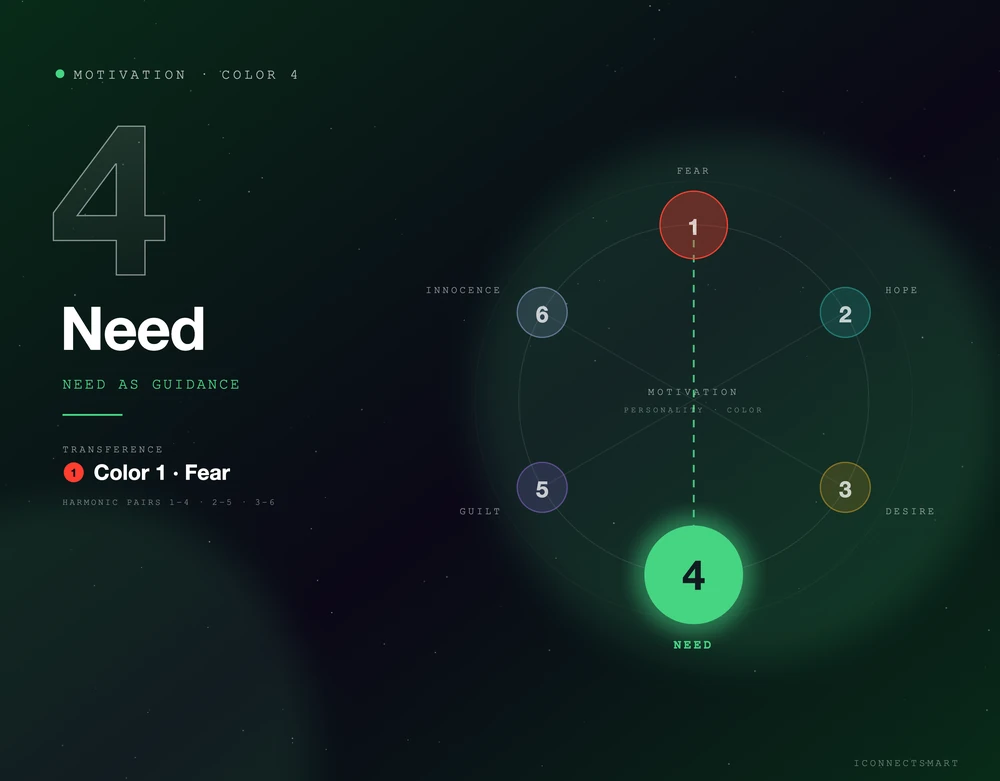

The Six Motivations of the Not-Self
Recognize transference motivations derailing awareness; restore correct perspective
Purchase is processed securely via Jovian Archive
When you buy through this page, you also support the ongoing creation of deep Human Design resources on IConnectSmart – at no extra cost.
The Mind That Knows What Matters

Watch someone walk into a room full of problems, and instead of listing everything wrong with it, they name the one thing blocking everyone. They skip the ten things that could be better and go straight to the one that matters. Once they say it, everyone in the room realizes they had been circling that spot the whole time without landing on it.
There is nothing accidental about that. It is a specific kind of intelligence, and if you’ve ever been the person who does this without quite knowing how, it helps to understand what is happening underneath it.
Start with what this is, because the label, need, sounds almost like a shortfall until you understand what it points to. Need here has nothing to do with lacking something. It is discernment: the capacity to look at a situation and cut straight through everything that doesn’t matter to land on the one thing that does.
It is a precise read, and much narrower than a broad audit.
It is easy to undervalue this if you’re the person doing it. If you consistently know what a friend needs to hear, which resource would unblock a stuck project, and what is missing while everyone else is still listing symptoms, that is no accident. Your mind is built specifically for this, and it is rarer than people give it credit for.
What makes this kind of clarity different from generic advice-giving is who it is aimed at. This intelligence is oriented toward the people you already know, your network, the community you move through day to day, and it was never built for strangers in crisis or a wide audience watching from a distance. The whole function is understanding what these specific people need and meeting them there, instead of offering something broad enough to apply to anyone.
This mechanism doesn’t build the same way in everyone carrying it. Some people start wide open, absorbing everything and gradually converting that breadth into precision as they go, beginning as a novice and slowly becoming someone who understands what a specific group requires. Others stay open in a more continuous way, shaped less by strategic accumulation and more by whatever the environment keeps drawing out of them.
The paths differ, but the underlying function is the same: figuring out what is needed, and delivering that and nothing more.
When this is working correctly, it barely feels like effort. The mind just knows, cleanly, without churning through possibilities first. That effortlessness is the signature of it working right, and it comes from a mind built to see past the noise straight to what matters, even when the answer was obvious to nobody else.
When discernment turns inward
There is also a way this turns inward that is easy to miss while it’s happening, and it deserves a clear description.
Picture the moment that outward clarity stops pointing at other people’s needs and starts pointing, urgently, at your own security instead. The question quietly shifts from what does this room need to what if this all falls apart underneath me.
The cruel part is that this kind of mind was never built to investigate foundations in the first place. That is someone else’s specialty. Reaching for it anyway means arriving there without the tools to use it.
What comes out is circular, and nothing like productive concern that leads somewhere useful. The anxiety has no bottom to hit and no resolution to land on, because the mind chasing it was never designed to do that particular kind of digging. It spins, burning energy, delivering nothing to the people who needed something real from you.
Take a concrete case. Say you’re in a meeting about a struggling project. In correct form, you read the room and name the one structural gap holding everything back: the missing piece, the unspoken assumption, the specific clarification that would unstick the next step.
People trust what you say because it’s focused and it’s clearly right.
In the other version, you sit in that same meeting and can’t access any of that precision, because your mind is somewhere else entirely. It is churning on job security, on threats you can’t quite name, on risks you haven’t researched enough to justify the panic. Instead of the insight the room needed, you project unease into it, and the group absorbs that unease instead of getting the clarity they came for.
The solution was right there. It couldn’t get through the noise.
Or picture this closer to home, inside your friendships. In your natural frequency, you’re the one who instinctively knows which friend needs a direct conversation and which one needs space, which one needs a real resource and which one needs someone to witness what they’re going through. That quiet precision is a real gift, and it moves without much fanfare, filling what is missing without overextending into more than was asked for.
In the sideways version, that same sensitivity turns on itself. Instead of reading what others need, you start reading, with rising urgency, whether your own place in the group is secure. Suddenly you’re anxious about what people think of you, uneasy about anyone new entering your circle, quietly convinced your belonging is shakier than it really is.
You start seeking reassurance instead of offering discernment, which is almost the opposite of what this whole capacity was built to produce.
The thread through both is the same: precision replaced by panic, outward clarity replaced by inward scanning for threats that were never there to find. In either case the mind is reaching for a kind of intelligence that was never its own to begin with.
Trusting the read you already have
Trying to think your way out of the anxiety will not bring this back, and neither will willpower applied against the spinning. That approach is the trap itself, because it keeps the transferred mind churning on a question it was never built to answer. The return runs somewhere else entirely: through the body’s own navigation, letting that realignment happen underneath the mental noise instead of on top of it.
Once that happens, the field of what is essential comes back into focus on its own. The noise quiets. Whatever mastery you’ve built, or are still building, becomes accessible again: the ability to see what is required and hand it over cleanly, without your own insecurity distorting the signal on the way out.
Hold onto this about the gift, especially with so much unsolicited opinion and generic advice around. It is quieter and more intimate than the sweeping, broadcast intelligence built for strangers in crisis. It is a mind that knows its people well enough to see what each one needs, and has the discipline to offer only that instead of everything it knows.
That discipline is the real skill, and it is easy to overlook because it looks effortless from the outside. You don’t overwhelm people with information or prove how much you understand. You deliver the one thing that matters to the right person at the right moment, with a precision that only real discernment can produce.
Where has this been turning inward on you lately, the discernment quietly curdling into worry about your own footing instead of staying pointed at what the people around you need? What would it look like to trust the read you already have, instead of chasing reassurance you were never built to find that way?

