
Intermediate 1: The BodyGraph | Centers, Channels, and Gates
Decode BodyGraph mechanics to understand energy, relationships, and life
Purchase is processed securely via Jovian Archive
When you buy through this page, you also support the ongoing creation of deep Human Design resources on IConnectSmart – at no extra cost.
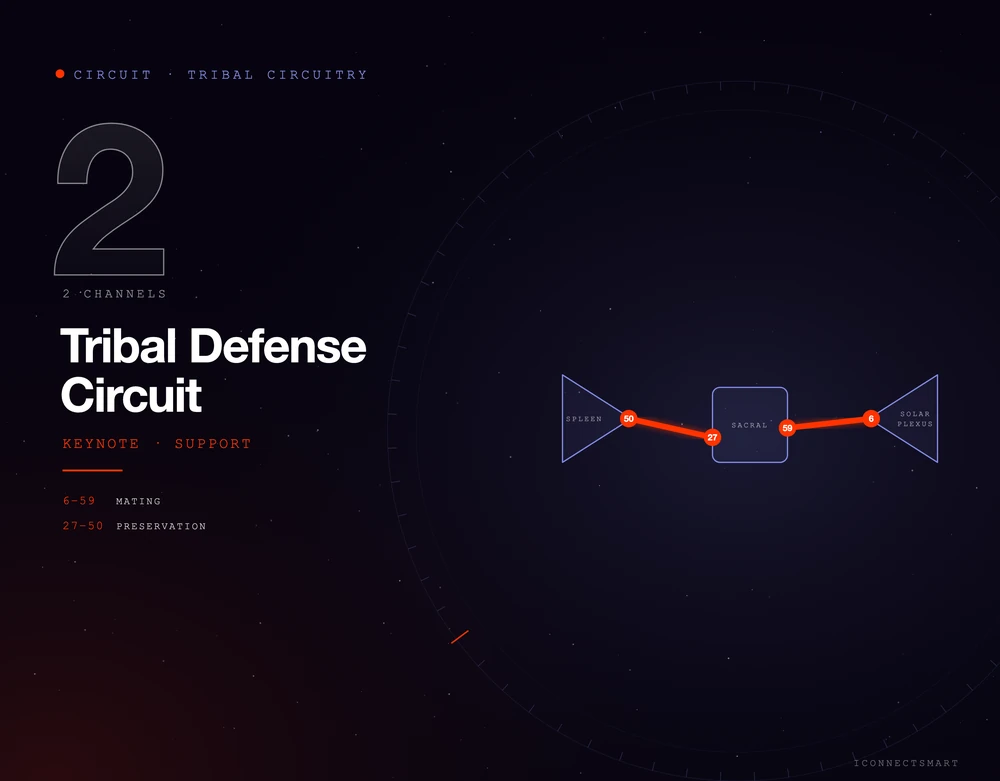
The Essence of the Tribal Defense Circuit

You have probably met someone who could make a total stranger feel instantly close within minutes of meeting them, with no visible effort and no obvious technique, just a kind of warmth that dissolved the usual careful distance people keep. And you have probably also watched that same warmth get misread more than once, as flirting, as promising something it never meant to promise, simply because it moved faster than the usual social rules expect.
That is a specific, mechanical force built directly into some people, not a communication problem. Understanding what it is doing changes how you navigate it, whether you are the one carrying it or standing near someone who is.
The Channel of Mating and fast closeness
Start with what this force does, because the plain mechanics matter more than the poetic description. Something in this design breaks down energetic boundaries, functionally and not metaphorically, letting someone step into another person’s personal space with an ease most people never have access to. Charm in the usual sense has little to do with it: this is a built-in force whose entire purpose is dissolving the distance that normally keeps two people at arm’s length.
What makes this force tricky to carry well is that the same mechanism runs alongside a real emotional wave. That means the process of building real intimacy through it is never instant, however fast the initial connection feels. What arrives quickly here is proximity, and what still needs real time is clarity about whether that proximity is right.
Picture the specific trap this creates, because it is a common one. Two people feel an immediate, powerful pull toward each other, and the aura-breaking force does its job fast, so suddenly there is a sense of closeness that would normally take much longer to build.
If either person mistakes that fast closeness for emotional clarity, and commits while riding a high or a low, the bond they built can feel completely wrong once the wave settles into something steadier. What felt like destiny in the moment can just as easily turn out to be a wave spike mistaken for a signal.
Whether this force is yours or you are navigating a relationship with someone who carries it, fast closeness and a trustworthy bond are two different things. The speed is real, but it is never the whole story, and treating it as the whole story is usually where the regret comes from later.
This same dynamic shows up outside romance too, and it explains a specific kind of workplace confusion that can otherwise feel baffling. Someone carrying this force can build trust with a potential business partner remarkably fast, breaking down the normal professional caution almost effortlessly. The trap here is identical to the romantic one: treating that fast trust as proof the partnership is sound, when it is only an opening that still needs the same patience any real collaboration requires before it is launched into the world.
There is a social cost too, and it is a real source of friction for people carrying this force. Because the ease of connection is so natural and so fast, it often reads to other people as flirtation or pursuit, even when nothing of the kind was intended.
If you have been repeatedly misread this way, that calls for no apology. It is simply the visible signature of a force that moves faster than most people expect. The fix is to stay anchored in gut response, instead of suppressing the warmth or letting the momentum of the connection make decisions on your behalf.
The Channel of Preservation and real care
Once real intimacy or real collaboration has taken hold, though, something completely different needs to take over, because creating a bond and sustaining it are two entirely different jobs, requiring two entirely different kinds of intelligence.
This second force is cooler, more grounded, built for care instead of connection. Where the first force runs hot and moves fast, this one operates through instinct, intuition, and judgment, the specific kind of intelligence responsible for protecting and nurturing whatever the first force helped bring into being. If the aura-breaking force creates the spark, this is what makes sure the spark survives long enough to grow into something lasting.
In practice this force has two halves, and they work together. One half generates the energy to nourish and support whoever is vulnerable: the young, the weak, anyone who needs real care to reach their own maturity. The other half sets the standards, the real boundaries, that define what is acceptable within that care.
Nurturing without any boundaries only produces dependence, and boundaries without any real nurturing only produce coldness. This force is built to hold both at once.
One specific instinct here explains a kind of behavior that can look controlling from the outside when it is protective. Something almost like a herding instinct runs through this force, a pull toward gathering people together for mutual protection and shared resources, watching over the group the way a guardian watches over what has been entrusted to them.
The crucial caveat is where this force most often goes wrong. This entire capacity for care only functions correctly when it is guided by real gut response, checking honestly whether there is energy available to give before committing to give it. Skip that check, and the same generous instinct that could have sustained real care instead collapses into quiet servitude, giving until there is nothing left, and calling the depletion selflessness right up until it becomes real burnout.
If you recognize this in yourself, caring for yourself first is the precondition for carrying your responsibility to others at all, sustainably, without eventually resenting the very people you set out to protect. Selfishness has nothing to do with it.
This shows up clearly in leadership, and it reframes something that can look harsh from the outside. Someone carrying this well in a group or organization is often the one trusted to set real standards of conduct, to enforce the boundaries that keep everyone functioning safely together. Done correctly, this is functional responsibility, not rigidity for its own sake: less about managing individual feelings and more about protecting the infrastructure the whole group depends on to keep working over the long run.
Put these two forces together and you get a complete system, not two separate traits. One force generates connection, breaking down the distance that normally keeps people apart. The other sustains what that connection produces, providing the judgment and the boundaries needed to protect it over time.
Neither one works well without the other. Fast connection without custodianship burns out, and careful custodianship without any real connection never has anything worth protecting in the first place.
Where in your own relationships or work has fast, easy closeness been mistaken for something more settled than it was? And where has real care quietly slipped into depletion because the check with your own gut got skipped along the way?
Tribal Circuitry


Stream of Instinct

Stream of Sensitivity
Voice of Tribal Circuit
The Defense Circuit
Defense channels
Asked & Answered
A circuit in Human Design focused on reproduction, nurturing, and preserving life—mainly through channels 59-6 and 27-50.
No. It’s about intimacy and bonding, which includes sex but also emotional merging.
Over-caretaking. Turning into a martyr or using help as control.
No, but Gate 6 is in the emotional center, so if defined, your bonding process must follow emotional clarity.
Absolutely. It’s ideal for HR, culture building, coaching, team development, and wellness.
Follow your Strategy + Authority. Set boundaries. Only care when it’s correct for you.