
The Throat: The Voices of Babel
Understand the 11 distinct voices of the Throat Center
Purchase is processed securely via Jovian Archive
When you buy through this page, you also support the ongoing creation of deep Human Design resources on IConnectSmart – at no extra cost.
Of all the nine centers in the Human Design BodyGraph, the Throat holds a singular position. It is the great converter — the place where every current of energy flowing through the system ultimately arrives to be transformed into something the world can receive: a word spoken, a decision made, a body moved to action. Ancient Rome was said to have all roads leading to it. The Throat is something similar — a hub toward which all inner life travels before it can become outer reality.
This alone makes it worth understanding carefully.
Asked & Answered
Not exactly. Communication is a side effect. Mechanically, the Throat is about manifestation: turning energy into expression, action, or impact.
A defined Throat tends to express more consistently. An undefined Throat is more variable, often amplifying others and learning timing and correctness around attention.
That’s usually mental pressure, social conditioning, or an open/undefined Throat trying to secure attention or certainty. It typically creates distortion, not clarity.
When your Strategy + Authority says yes. Correct speech has a clean feeling: less urgency, less proving, more impact.
Yes, often extremely powerful. The mastery is learning not to force expression and not to chase being noticed.
Expression still happens, but the “how” changes. The presence/absence of connections to the Throat affects consistency, timing, and the style of output.
The eleven voices

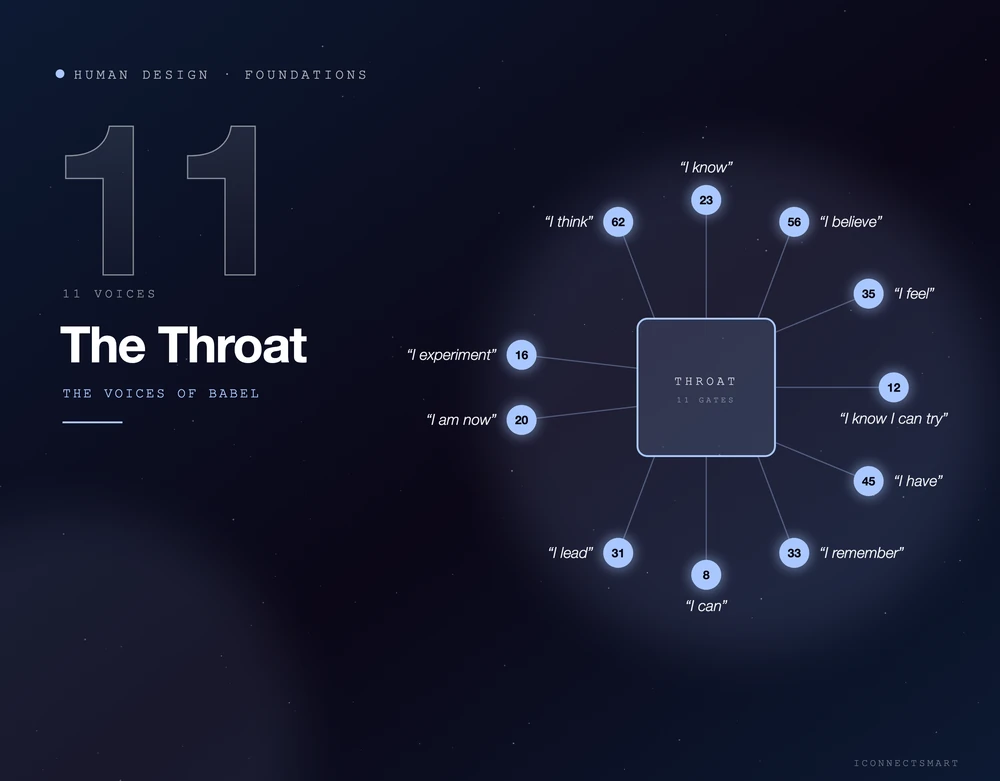
What makes the Throat distinct from a simple output mechanism is its internal complexity. It contains eleven gates, each encoding a different mode of expression — not just different topics or tones, but different fundamental relationships between a person and what they are communicating.
Gate 62 says “I think.” It is the voice of the organized, factual mind — the capacity to name things precisely, to arrange logical details into communicable form. Gate 23 says “I know,” but it carries something wilder: individual insight, the kind of knowing that arrives whole and can’t always be explained by steps. Gate 56 says “I believe,” which turns out to be less about conviction and more about storytelling — translating abstract experience into parables others can enter. Gate 16 says “I experiment,” driven by enthusiasm and the need to master skills through repetition. Gate 20 says “I am now,” the most purely present voice — existential awareness spoken without delay.
Gate 31 says “I lead,” but only when elected; leadership without consent, in this framework, is just noise. Gate 8 says “I can,” and is less about grand leadership than about demonstrating a unique way of doing things — the creative role model. Gate 33 says “I remember,” but it is a stopping voice, signaling retreat and reflection before any lesson can be meaningfully shared. Gate 35 says “I feel,” perpetually hungry for new experience, always pushing the collective toward movement. Gate 12 says “I know I can try,” though its reach is more atmospheric than physical: it governs the tone and mood through which mutative ideas enter social space. And Gate 45 says “I have,” the tribal voice of stewardship, directing the distribution of what belongs to the group.
Each of these voices operates between two poles — what the system calls a binary quality. Gate 62 swings between reasonable and unreasonable. Gate 23 between insistence and desistance. Gate 12 between caution and abandon. These aren’t moral categories so much as mechanical ones: the voice is either working with its nature or working against it, and the difference is usually whether the speaker has honored the timing.
Footage note – replace this line in the editor
The central problem of timing
Across all eleven voices, one theme recurs with striking consistency: the distorted version of every gate involves speaking too soon, without invitation, without readiness, or in the wrong conditions. Gate 23’s mutation becomes alienating when shared prematurely. Gate 33’s wisdom loses its depth when verbalized before the period of private reflection has concluded. Gate 12’s impact is undermined when social openness is forced rather than felt.
This points to something important about what the Throat Center is actually governing. It is not merely a mechanism for producing speech. It is a gate between inner states and outer reality — and the quality of what passes through that gate depends on whether the inner state has had time to mature into something genuinely communicable. The voice that rushes does not carry its full weight.
Defined and undefined: two very different relationships to expression
The distinction between a defined and an undefined Throat Center describes two fundamentally different orientations toward communication.
A defined Throat means a fixed, consistent connection from one or more inner centers to the outlet of expression. The voice is reliable — you can count on it to sound a certain way, to carry a certain frequency, because the channel supplying it is always lit. The risk here is the temptation to use that reliability carelessly: to speak when timing hasn’t been consulted, to fill silence just because the capacity to fill it exists.
An undefined Throat means something quite different. Without a fixed internal connection, this center becomes a kind of mirror — open, responsive, subject to the influence of whoever is nearby with a defined Throat of their own. The experience is one of pressure: a felt urgency to speak, to perform, to attract attention, to make oneself heard in order to feel real or recognized. The shadow of the undefined Throat is the chronic strategy of forcing expression in the hope of being seen.
The corrective, in both cases, is not more effort — it is less. The defined Throat is asked to trust its mechanism and wait for the right moment. The undefined Throat is asked to rest in receptivity, to let the environment create the opening rather than manufacturing one. In its highest expression, the undefined Throat becomes a connoisseur of authentic voice — capable of recognizing, with unusual precision, who in a room is speaking from genuine internal alignment and who is performing.
Expression as transformation
The deeper function of the Throat Center — encoded in its biological correspondence to the thyroid and parathyroid glands — is metabolic. These glands regulate growth and the conversion of energy into form. The Throat, understood in this light, is not simply where thoughts become words. It is where the invisible interior of a person becomes something that can affect the world: a voice that changes a room, a movement that begins something, an act that manifests what was previously only potential.
This means the quality of what we express is not just a matter of clarity or eloquence. It is a matter of whether what we are saying has actually been converted — whether the energy behind it has fully traveled its path from wherever it originated inside us to the moment it leaves our mouths. Expression that hasn’t made that full journey is, in a mechanical sense, premature. It carries less of what it was meant to carry.
The practical implication is quieter than it might seem. It is not a philosophy of silence, or an instruction to wait endlessly before speaking. It is simply the observation that the most powerful expression tends to arrive when it is ready — when something real has moved through its full cycle and emerged, rather than been pushed out ahead of schedule.
The Throat is where all of that becomes real.