Generator Series from ra uru hu

Purchase is processed securely via Jovian Archive
When you buy through this page, you also support the ongoing creation of deep Human Design resources on IConnectSmart – at no extra cost.
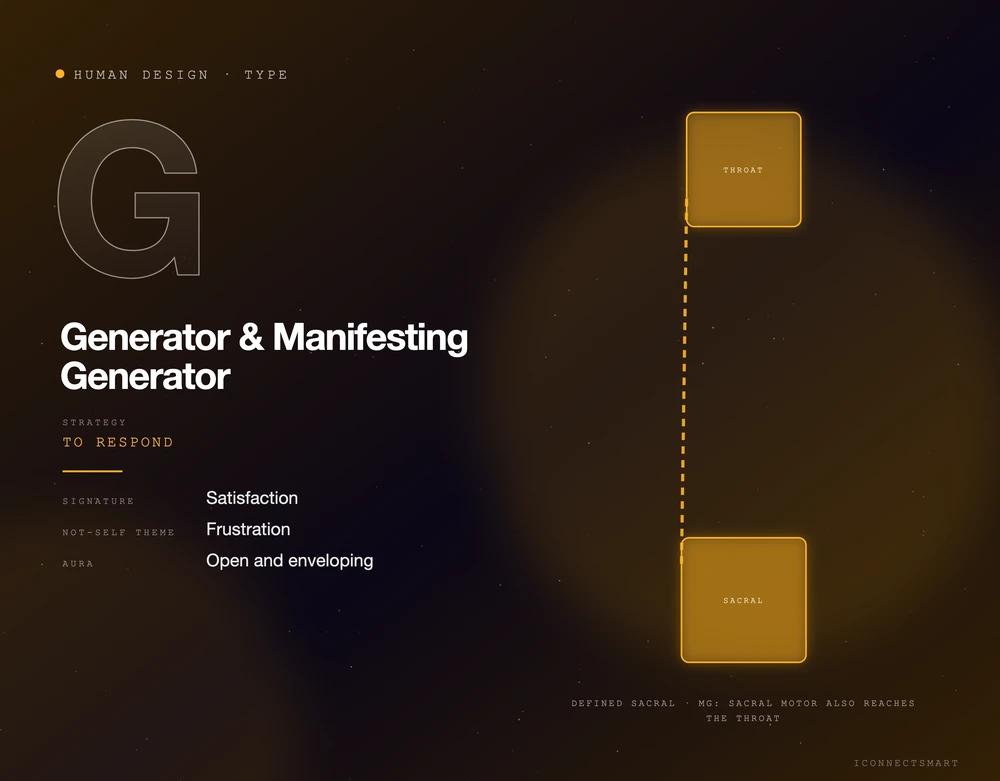
How to Be Satisfied
Footage note – GENERATOR & MANIFESTING GENERATOR – BUILDER (CLASSIC & EXPRESS)
Think about the last time you chased a goal that made total sense on paper and still felt like dragging a boulder uphill the entire way. You didn’t lack discipline or drive. What you probably lacked was a body-level yes for the thing your mind had already decided you should want.
If that pattern is familiar, chances are you’re carrying the most common design there is, and what went wrong was direction, never effort.
Start with the mechanics of what’s running in you. Somewhere in your body sits a motor, a defined source of energy built for sustained work, real creation, and the kind of engagement with life that doesn’t run out after one good push.
Willpower is something you apply from outside, and this is different. This is fuel that is already there, waiting to be pointed at the right thing.
What makes this design tricky to live well, especially in a culture that worships initiative, is that your energy was never built to go looking for its own targets. It was built to respond, to come alive when something real shows up in front of you. A goal your mind picked in the abstract because it sounded impressive or sensible does not count.
Initiate from the mind instead of waiting for something to respond to, and you’ll hit resistance almost every time, no matter how good the plan looked on paper.
A physical signal is built directly into you for this, and most people take it far less literally than they should. Before your mind even finishes forming an opinion, your body has already produced a gut-level yes or no, often nothing more articulate than a grunt, a lean, or a felt pull toward or away from something.
That inarticulate reaction is the most reliable navigation you have, and you never graduate out of it once you get serious about your life. Overriding it in favor of a cleverer argument is usually where the trouble starts.
If your gut says a flat no to something your mind has already built an entire justification for, believe the gut. It is neither stubborn nor irrational. It is the one part of you wired to know, correctly, whether this particular thing is worth your very real, very finite energy.
When you follow that signal, waiting for something real to respond to and saying yes only when the yes is real, what shows up is satisfaction. It is steadier than excitement or relief: the grounded feeling of having poured real energy into work that was yours to do. Treat that satisfaction as your compass, because it only shows up when you’re doing this correctly, and its absence is just as informative as its presence.
When you’re not following it, because you initiated from the mind, chased a goal nothing real ever triggered, or kept saying yes out of habit long after the energy was gone, what shows up instead is frustration. Frustration here is a plain, mechanical signpost telling you where you’ve drifted off your own path.
Mastery works in a particular way for this design, and knowing it explains a kind of stuckness that can otherwise feel like going nowhere. Real skill here builds step by step, and there will be plateaus, stretches where nothing seems to move no matter how much energy you put in.
If you got into the work by responding to it in the first place, you have the staying power to push through that flat stretch until a breakthrough opens up on the other side. The plateau is simply part of the shape mastery takes when it is built this way, and it says nothing about whether you chose wrong.
The Manifesting Generator
Now, roughly a third of the people carrying this design have a variation that deserves its own explanation, because it comes with real gifts and a real trap that looks nothing like the standard version above.
If you move from feeling to action almost instantly, with barely any gap between deciding something and doing it, you’re likely carrying this faster configuration. What makes it distinctive is an unusual eye for efficiency: an instinct for which steps in a process are essential and which ones are padding that can be skipped.
When this works well, it is remarkable to watch. Things that take other people significant time simply get handled, cleanly, with almost none of the wasted motion most processes carry.
The trap catches almost everyone with this configuration at some point. That same speed creates real impatience, and impatience has a cost. Moving fast enough, often enough, means occasionally skipping a step that mattered, a load-bearing piece and not padding, and then circling back to redo the whole thing anyway, which produces a very avoidable kind of frustration.
The efficiency is real, and it is not free. Learning where the true corners are, and where they only look like corners, is the skill to build here.
It is easy to assume this faster wiring means an exemption from the usual rules, and it doesn’t. The instinct to just go, to manifest something the moment inspiration strikes without waiting for a real external trigger, runs into the same resistance a standard build hits when it initiates from the mind.
The extra speed only becomes an asset once it is pointed at something real that showed up to respond to. Point it at nothing in particular, purely because the impulse felt strong, and you’ll hit the same wall everyone else does, just faster and with more momentum behind the collision.
Sleep, emotional authority and the mind
A couple of mechanical realities apply whichever version of this design you’re carrying, and ignoring them tends to quietly undermine everything else.
Sleep works differently here than the standard advice assumes. Your body’s daily supply of energy needs to be spent, and mental tiredness alone does not count, before real rest becomes possible. Go to bed carrying unused Sacral energy and you’ll likely wake up feeling like you never slept, no matter how many hours you logged.
The fix has little to do with discipline about bedtime. It is making sure the day’s energy got used doing something real before you lie down.
And for roughly half the people carrying either version of this design, there is an added layer: an emotional system that needs real time, never a single moment, to settle before a decision can be trusted. If that’s you, the gut response you’re waiting for is unavailable in the heat of the moment. It becomes available after the emotional wave has run its course, which makes patience structural here, built directly into how you’re wired to know anything for certain.
The throughline across both versions, and the one thing to remember above everything else, is that your mind was never meant to run this. It is a brilliant passenger, useful for understanding and communicating what your body already knows, but it was never built to decide what you do with your very real, very limited daily energy.
The decision belongs to the body. The mind’s job is to notice what the body already decided, and eventually, to say it out loud.
Where in your life right now are you pushing forward on something your mind approved of, but your gut never said yes to? What would it take to wait for the real yes, instead of settling for the plausible one?

Asked & Answered
Generators are designed to respond to life. Their power comes from the sacral “yes” — when they wait to respond, they align with satisfaction and sustainable energy.
Frustration arises when they initiate instead of respond. It signals they’re out of alignment with their sacral truth.
MG’s have both Generator and Manifestor traits. They’re designed to respond quickly, often skipping steps, and need freedom to move fast and pivot.
Like Generators, MG’s must respond first. But they also need to inform others of their actions to reduce resistance when shifting directions.