
Intermediate 1: The BodyGraph | Centers, Channels, and Gates
Decode BodyGraph mechanics to understand energy, relationships, and life
Purchase is processed securely via Jovian Archive
When you buy through this page, you also support the ongoing creation of deep Human Design resources on IConnectSmart – at no extra cost.
Unleashing Radical Individuality: The Truth About the Individual Centering Circuit in Human Design

You have probably watched someone go through something that should have flattened them, a job lost overnight or a life rearranged in a single accident, and come out the other side more themselves than before. They did not manage that despite the disruption but because of it. Something in them used the shock as a doorway instead of a wound, and you could not quite explain how they pulled it off.
Some people are wired for that kind of doorway. If that is you, understanding the mechanics of it changes how you relate to disruption for the rest of your life.
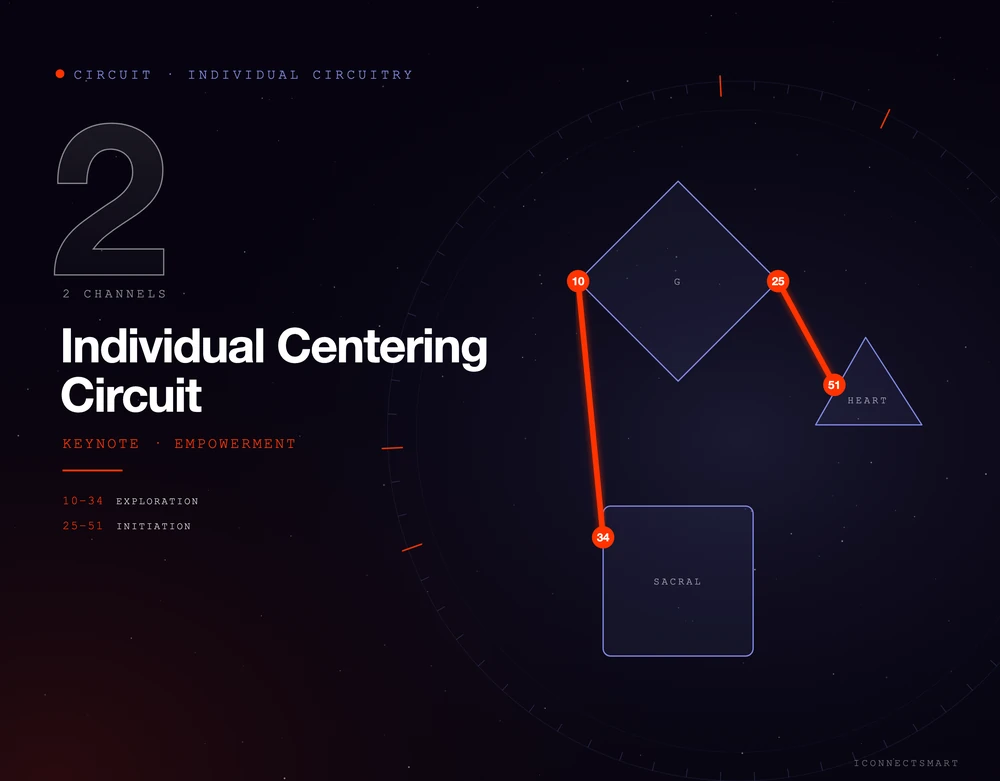
The Channel of Initiation and the power of shock
Start with the piece responsible for the shock itself, because it deserves a precise description more than a romantic one. Something in this design exists to disrupt stagnation, and it does so through direct confrontation with reality, the kind that forces a reckoning where a slow drift toward change would never happen. This is the mechanism behind the moment someone stops identifying as part of a “we” and abruptly claims an “I” instead.
What makes this force tricky to carry is that it needs to be recognized and invited before it works the way it is supposed to. Force it uninvited into a group or a relationship, and the same disruptive power that could have catalyzed a breakthrough only destabilizes everything around it, without producing anything worth the damage.
The shock itself is neither good nor bad. It is a tool, and like any tool with this much force behind it, timing and invitation are what separate a breakthrough from a wreck.
Picture what this looks like when it is working correctly. Someone gets brought into a stuck organization to shake it loose, introducing an approach so different from business as usual that it stretches everyone past their comfortable limits, and that stretch is what turns a stagnant, forgettable company into something with an identity of its own. The disruption was never cruelty. It was calibrated and invited, and it worked because the invitation was real.
The same mechanism has a more personal version, and it explains something that can look like a mystery even to the person living through it. Sometimes life itself delivers the shock without anyone inviting it first: an accident, a sudden loss, an event nobody chose.
What separates someone wired for this from someone who simply gets flattened by the same event is what happens next. Instead of collapsing into the trauma of it, something in this design can use the rupture as a leap, a doorway into a far more direct, unguarded sense of who they are, discovered because the old scaffolding got knocked away.
If a hard, unchosen event in your life ended up clarifying who you are instead of only damaging you, that was neither luck nor some unusual resilience pulled from nowhere. It was this mechanism doing what it is built to do, using confrontation with reality as the doorway into something realer than what came before.
This force also has a quieter, more social version, and from the outside it can look like something else entirely. Some people carry this energy simply by constantly testing their own limits, physically or creatively, in ways that quietly provoke everyone around them into wanting to test their own. No instruction is involved, only a visible, gutsy willingness to risk something real, which tends to make everyone nearby a little braver by proximity alone, whether or not a single word about it ever gets exchanged.
The Channel of Exploration and living your convictions
Right alongside this shock-based force sits something almost the opposite in temperament, though it is built for the same underlying purpose: protecting and expressing an individuated self.
This second force works through sustained conviction, the raw, steady strength to stand by what you believe about yourself, entirely independent of whether anyone else approves. The important mechanical detail is that this force only operates correctly through a real, felt gut response.
Run it purely through mental justification instead, and the whole thing loses its power. It has to be rooted in something your body says yes to, and an idea your mind has decided sounds admirable is no substitute.
In practice it looks like this. Someone takes on only the work that lights something up in their body, refusing to compromise that standard just because the market wants something more conventional. They are not being difficult for its own sake.
They are staying loyal to a real internal signal, and the mastery that comes from following that signal consistently over years tends to draw attention eventually. They were never chasing it. Authentic, self-directed work simply has a quality that is hard to fake and hard to ignore once people notice it.
This one has a more personal version too, and from the outside it can look eccentric when it is simply integrity. Someone might live in a way that seems unusual to everyone around them: off-grid, unconventional, structured entirely around a deep internal conviction instead of any external template for what a normal life should look like.
What is happening here is not rebellion for its own sake. It is someone who feels no need to explain or justify a choice their own body has already confirmed is correct, and that quiet lack of apology shows others something, even when no words are exchanged about it.
If you have ever felt a low hum of pressure to explain a life choice that you know, in your body, is right for you, that hum was never a sign you owed anyone an explanation. Real conviction, rooted in response instead of borrowed justification, does not require defending. It only requires living.
In close relationships this same force clarifies a specific trap that is easy to fall into without realizing it. It is possible to get pulled into staying constantly busy for other people, managing everyone else’s needs and filling every role a family or a group seems to want filled, instead of following your own responses to your own life.
The correction here is neither coldness nor withdrawal. It is refusing to let other people’s expectations override your own gut-level yes and no, and trusting that being visibly, unapologetically yourself is a real contribution, without needing to be constantly useful to prove it.
Both forces tie together, even though they look so different in practice. One works through sudden confrontation, forcing a leap into individuality through shock and disruption. The other works through sustained, quiet conviction, building individuality through steady, unglamorous consistency over real time.
The rhythms differ, but the purpose is the same: carving out a self-directed identity that does not need collective agreement to be valid.
What both of them also share is a dependence on being recognized instead of forced. The shock only lands correctly when it has been invited. The conviction only becomes a gift to others once it is simply lived, visibly, without insisting anyone pay attention to it.
Neither force works by pushing. Both work by being real enough, consistently enough, that recognition eventually finds its way there on its own.
Where in your life have you been softening a conviction, or avoiding a disruption you needed, because neither one had been formally invited yet? What would it look like to trust that living it fully is enough, whether or not the invitation ever comes?
Individual Circuitry


Stream of Knowing

Stream of Intuition

Stream of Emoting

Format, Tantric and Leadership channels
The Centering Circuit
Centering channels
Asked & Answered
The Individual Circuit, focused on self-directed action and spiritual alignment.
The capacity to shock oneself and others into awakening through courageous action and spiritual love.
It’s conviction in motion—acting from self-love and integrity without apology.
Yes. They are often hijacked by ego or misused to seek validation.
Only if you’re trying to fit in. It becomes pure power when you accept your uniqueness.