
Intermediate 1: The BodyGraph | Centers, Channels, and Gates
Decode BodyGraph mechanics to understand energy, relationships, and life
Purchase is processed securely via Jovian Archive
When you buy through this page, you also support the ongoing creation of deep Human Design resources on IConnectSmart – at no extra cost.
The Role of Collective Logic in Human Design

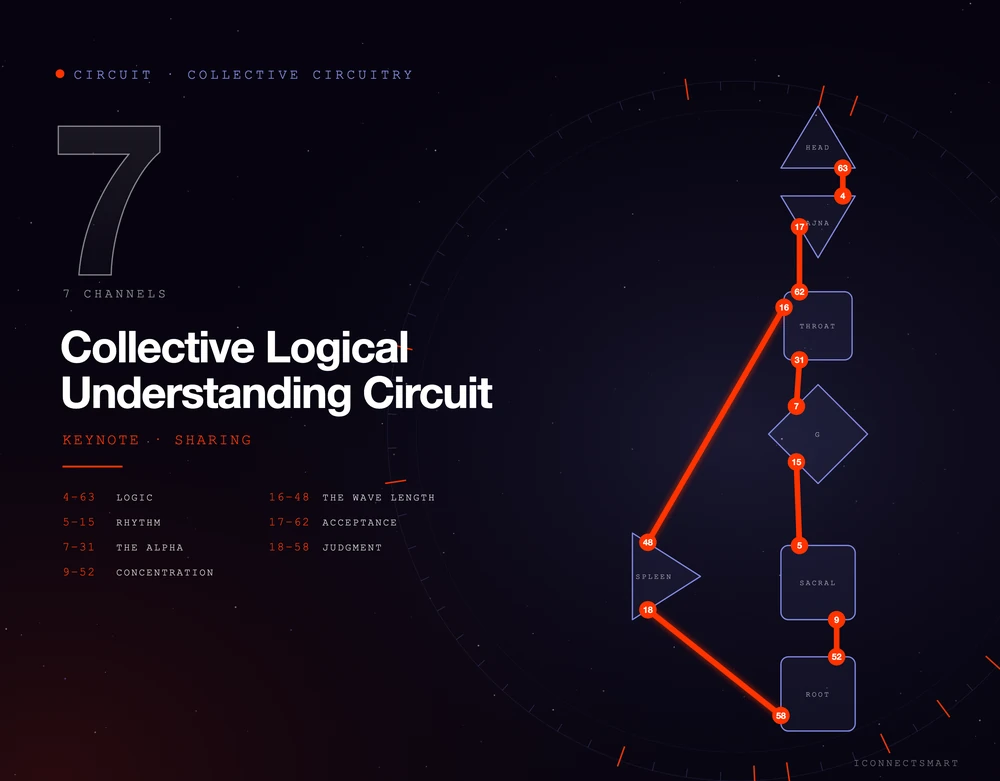
You have probably sat completely still for an hour, so absorbed in getting one detail right that you forgot to eat, forgot to check your phone, forgot the rest of the room existed. You were not stressed and not forcing it, just locked in, quietly, on the one thing that mattered until it made sense.
That stillness is a specific kind of intelligence, not a personality quirk, and it is built to serve everyone eventually, even though it looks completely self-absorbed while it is happening.
Start with the fuel underneath this whole way of thinking, because it explains why the stillness matters so much. There is a real strength here built on staying physically quiet while paying intense, sustained attention to detail. The focus is calm and grounded, a kind of pressure that stabilizes instead of stressing.
This is far from idle sitting. It is the specific condition required before any pattern can be properly assessed, corrected, or trusted enough to share.
If you need real stillness before you can think clearly, that is neither laziness nor resistance to action. It is the correct operating condition for a mind built to evaluate details thoroughly before committing to a conclusion, and skipping the stillness usually means skipping the accuracy too.
A second thread runs underneath this same intelligence, older than any of the more visible pieces: a rhythm shared with every living cell, the most basic pattern of flow that life itself runs on. This shows up as a pull toward consistent routines and fixed patterns on one side, balanced against an appreciation for extremes and variation on the other.
When someone is in sync with their own natural rhythm, action stops feeling effortful and starts feeling almost automatic. The work did not get easier. The timing finally matched what the body was already asking for.
In practice this explains a specific kind of magnetism that does not announce itself loudly. Someone who honors their own fixed rituals, their own consistent tempo, tends to quietly stabilize everyone working around them, without instruction, simply by being reliably and visibly in their own flow. People get drawn into that steadiness without fully realizing why, the same way a group naturally settles into the pace of whoever seems most at ease.
From stillness and rhythm, this intelligence moves toward something more outward-facing: leadership, though not the loud, self-appointed kind. This version of leadership works by identifying a viable path forward based on patterns that have already been tested against real experience, then articulating that direction clearly enough for other people to follow it.
The mechanical catch is that this kind of leadership is fundamentally democratic. It requires real invitation and real collective consent before it can function correctly.
This is easy to resent if you carry it. Your read on the right direction might be completely accurate, and it still will not land as leadership until people have asked you to lead.
Push it forward uninvited, however correct it turns out to be, and it tends to read as overreach instead of guidance. Wait for the invitation, and the same insight becomes something people trust enough to follow.
Correction, mastery and doubt
A sharper, more critical piece of this intelligence can feel uncomfortable to carry. Some real, restless pressure lives here, an almost insatiable drive to notice what is off, what has decayed, what has fallen below the standard something used to hold.
Negativity for its own sake has nothing to do with it. This is an adrenalized push toward restoring integrity to systems that have quietly gone stale, and the discomfort it generates in the person carrying it is often the first sign that correction is needed somewhere real.
The same rule shows up again, because it is consistent across this entire intelligence: this critical eye works best when it has been invited. Offered to someone who wants to be challenged, it sharpens everything it touches. Forced onto someone who never asked for the correction, it only reads as criticism, however accurate the underlying observation happens to be.
A slower, quieter piece of this intelligence is built around mastery, and it corrects a common misunderstanding about talent. What shows up here was never a gift someone was simply born with. It is depth, made functional through repeated practice over real time: intuitive insight paired with the patient, sometimes tedious work of refining a specific skill again and again until it stops being technique and starts being something closer to expression.
If you have ever felt frustrated watching yourself take years to get good at something that seemed to come easily to other people, that slower path was never a sign of lesser ability. It is how this particular kind of talent is built to develop, with depth accumulated through commitment instead of handed over instantly, and the eventual mastery tends to run deeper because it was earned.
One uncomfortable piece of this intelligence can feel like a problem when it is an asset. Some real doubt runs through here, an active, restless scrutiny that keeps checking patterns for inconsistencies, generating questions instead of settling comfortably into easy answers.
This doubt has nothing to do with insecurity. It is the mechanism that keeps conclusions honest, because even careful logic can still be wrong, and the discomfort of continuing to question is often what catches the error before it becomes a real problem.
If you are the person who keeps poking at a plan everyone else has already agreed to, unable to let the inconsistency go unexamined, that persistent doubt is a safeguard, and it has nothing to do with being difficult. The questions it generates usually deserve to be asked out loud instead of swallowed to keep the peace.
And finally, one piece of this intelligence is responsible for organizing everything the rest of it produces into something usable. This is an ongoing internal process of sorting, structuring, and refining information: visualizing what the correct pattern is, then translating that internal picture into language detailed and clear enough that other people can evaluate and act on it.
Someone carrying this well is doing more than holding a lot of information. They are constantly filing it, updating it, incorporating what other people bring to the picture, until what emerges is coherent instead of merely accumulated.
Logic that is built to be shared
On their own these pieces can look like scattered, unrelated talents, but one thing ties them together. Every single piece of this intelligence is inherently social at its core, even the parts that look completely solitary from the outside.
The stillness, the rhythm, the leadership, the criticism, the slow-built talent, the doubt, the organizing: none of it exists purely for the private benefit of the person carrying it. All of it is built, eventually, to be shared, tested, and used by people beyond the individual holding it.
A specific vulnerability shapes how this intelligence functions in the real world. The parts of this system responsible for communicating its findings do not connect directly to sustained, self-generating energy. That means good ideas here often need real collective effort, real external backing, real collaboration, before they can move from private insight into something built and used.
Carrying brilliant logic alone is not usually enough. It needs a channel to move through, same as everything else in this system that depends on being invited before it can do its real work.
What might feel like a limitation is closer to an honest design constraint: this whole intelligence was never built to operate in isolation, however solitary its process can look from the outside. The stillness is private. The eventual sharing was always the point.
Where in your own thinking have you been sitting on an accurate insight, waiting for a real invitation before offering it, instead of assuming the accuracy alone should be enough to make people listen? What would it look like to trust that the invitation is worth waiting for?
The Understanding Circuit
FutureThe Logical Mental Process
Stream of Understanding

Stream of Taste

Format, Tantric and Leadership channels
Asked & Answered
A circuit focused on future prediction, pattern recognition, and organizing systems for societal evolution.
Yes. Many charts have both, which creates dynamic internal tension and potential integration.
No. But it’s essential for structure, clarity, and sustainability.
Because knowing isn’t the same as correct timing. You must wait for Strategy and Authority.
Fields like engineering, analytics, teaching, data science, or leadership in systems-based organizations.