
The Six Motivations of the Not-Self
Recognize transference motivations derailing awareness; restore correct perspective
Purchase is processed securely via Jovian Archive
When you buy through this page, you also support the ongoing creation of deep Human Design resources on IConnectSmart – at no extra cost.
The Wisdom of Pure Witnessing

You’ve probably known someone who never seemed to be trying to influence anyone, and somehow influenced everyone. They didn’t give advice unless you asked twice. They didn’t correct the room. They just kept living their own life with such total presence that people quietly started orienting around them, without anyone ever announcing that’s what was happening.
It is a specific kind of power that doesn’t look like power at all, which is why most people miss it, and it has little to do with charisma in the usual sense.
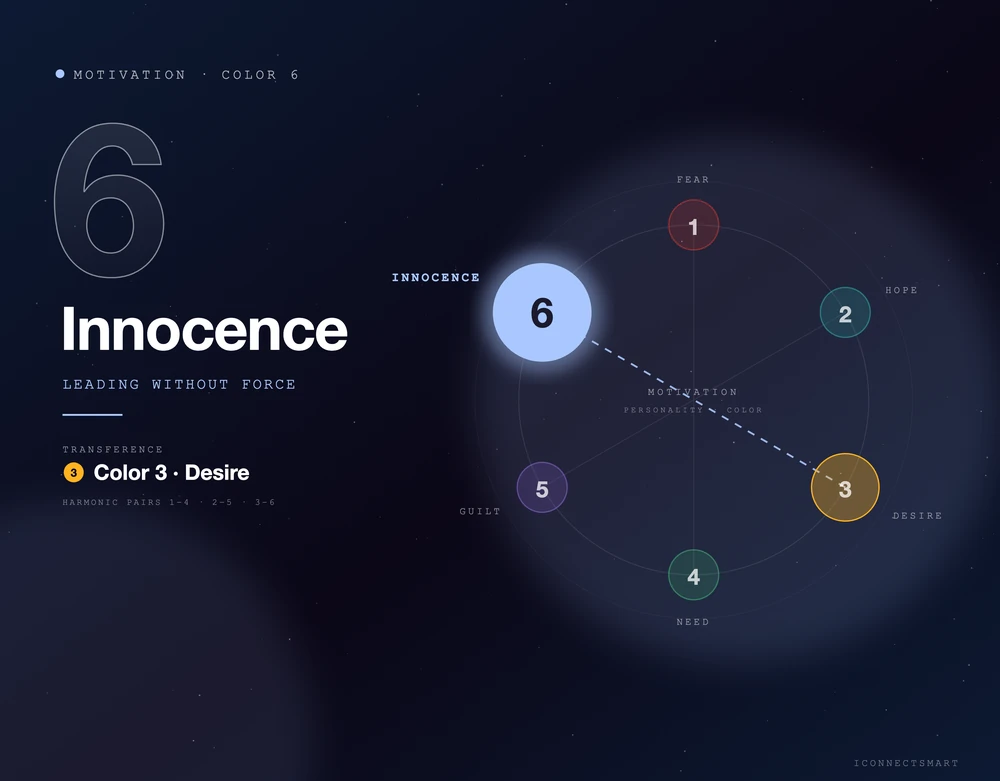
Start with what this is, because the word attached to it, innocence, invites the wrong picture immediately. It has nothing to do with naivety, softness or checking out of a difficult situation. Innocence here is the state of a mind so fully present to what is happening that it has no impulse to interfere with it, correct it or steer it somewhere else.
It is easy to mistake this for passivity if you’ve never lived it from the inside. If you can watch a situation unfold, even a hard one, even one you have opinions about, without feeling pulled to fix it or redirect it, you are not avoiding anything. You have a capacity most people never develop, and it is rarer than any of the louder virtues get credit for.
There is a phrase for this kind of watching: not this, not that. You are neither for nor against, neither chasing an outcome nor avoiding one, just present, without the constant low hum of preference running underneath everything you’re seeing.
One thing needs saying directly, because it sounds almost uncomfortable at first. This quality is described as deeply, unapologetically self-absorbed, and that means centered on your own unfolding instead of on managing anyone else’s, with nothing selfish about it in the small sense.
You’re not here to carry other people’s transformation for them. You’re here to be fully, honestly yourself, and something about that honesty ends up doing more for the people around you than any amount of guidance ever could.
That is the paradox: influence through not interfering. Authority comes from having no agenda to push, and leadership happens by accident, as a byproduct of being real, without any strategy behind it.
This shows up in two different ways in the people who carry it. Some hold a more active relationship with watching: they deliberately stay a step back, observe carefully, and process what they see through their own internal lens before anything comes back outward. Others are more the ones being watched, people whose way of moving through the world quietly draws others in, without performing for anyone.
The postures differ, but the underlying quality is the same: no hidden agenda running underneath either one.
When presence hides an agenda
There is also a way this hides in plain sight, and it deserves a careful description, because it can look identical to the real thing from the outside.
Picture the moment the calm, detached presence stays the same on the surface while something else takes over underneath it. It is quieter and more specific than chaos: a preoccupation with outcomes, with who’s ahead and who’s behind, with being recognized as the one who sees things clearly. The witnessing hasn’t visibly changed, but the engine running it has.
This version is hard to catch because it doesn’t announce itself. You can sincerely believe you have no agenda while a very real desire to lead, to be seen as wise, to shape an outcome you won’t quite name out loud, keeps operating in the background.
It leaks eventually, and it always does. When it surfaces, whatever quiet authority you had built collapses fast, because that authority was never supposed to come from trying in the first place.
Take a concrete case. Picture someone standing in front of a group they’ve been asked to guide: a mentor, a leader, someone in a position where people are watching how they carry themselves. In correct form, they’re simply present, unattached to whether the group takes their example or ignores it, and that unattachment is what makes the example worth following in the first place.
In the other version, that same person keeps insisting, to others and to themselves, that they’re just here to observe, just offering perspective, with no real stake in the outcome. Meanwhile they quietly maneuver the conversation toward a conclusion they’ve already decided is correct.
The words say detachment and the behavior says otherwise. The people around them can usually feel the gap before they can name it, and that gap erodes the trust that real innocence would have earned effortlessly.
Or picture this somewhere more personal: a friend who tells you they’re only sharing an outside perspective, no pressure either way, while every question they ask quietly steers you toward the answer they’ve already decided you should land on. The framing is generous, but the intent underneath it has a destination in mind. The friendship usually absorbs that mismatch long before either person says it out loud.
The thread through all three is the same: the surface stays calm while the engine underneath shifts from real presence to a hidden hunger for a specific outcome. The mind has been pulled toward wanting something it keeps telling itself it doesn’t want.
Presence without an agenda
Effort will not bring this back, and neither will trying harder to suppress the hidden wanting once you notice it. That approach only creates a new agenda, the desire to be desireless, which is still a desire underneath everything. The real return is stranger and simpler than that: it runs through the body’s own decision-making, letting the realignment happen underneath the mind’s management instead of through it.
Once that happens, something settles without being forced to settle. The mind stops working so hard to figure out how to be present and simply becomes present again, the way it was always built to. What is unfolding in front of you becomes visible again, without the quiet filter of wanting something specific to happen distorting what you’re seeing.
Hold onto what this offers in a culture that measures worth almost entirely by visible effort and measurable impact. It asks for something different: contribute without controlling, and matter without managing anyone. Be so fully present to your own specific, unrepeatable experience that the presence itself becomes what other people learn from, and it works that way because you finally stopped designing anything at all.
Someone who watches, without an agenda buried in the watching, changes the thing they’re watching just by how fully they’re present to it. Someone who is simply themselves, without performing that self for anyone, becomes the person others quietly orient around, without either side ever arranging it that way on purpose.
Where has your own presence lately been carrying a hidden hope about how things should turn out? What would it look like to let that go, and trust that just being fully, honestly yourself is already enough, without needing to manage what anyone does with it?

