
The Definition from ra uru hu
Purchase is processed securely via Jovian Archive
When you buy through this page, you also support the ongoing creation of deep Human Design resources on IConnectSmart – at no extra cost.
Consciousness Came First
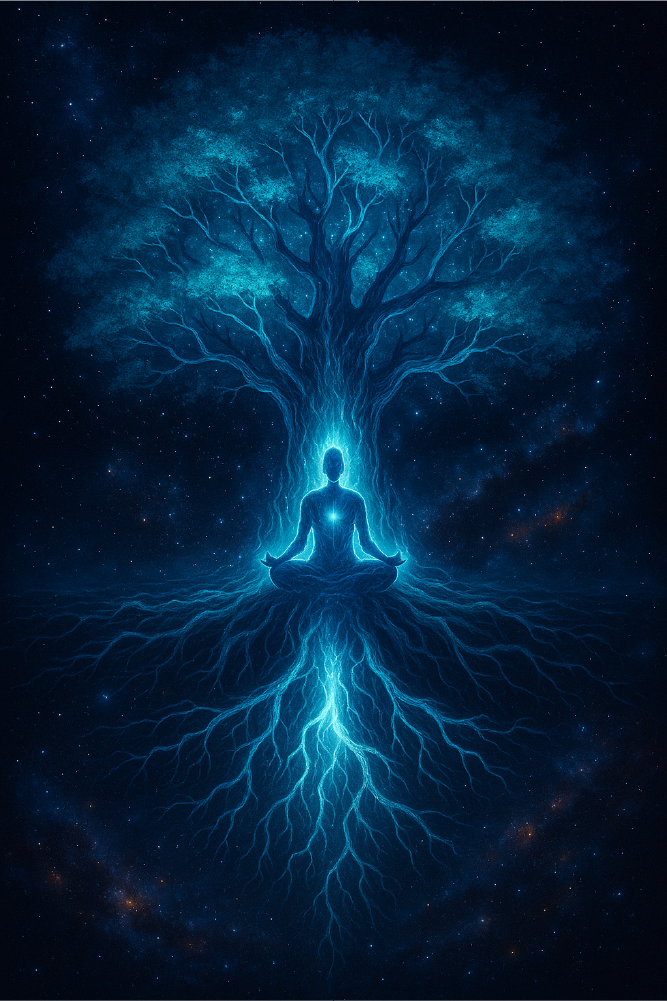
Close your eyes right now and notice that something is looking. Your eyes are closed, so it is something behind them, aware of the dark and aware of your own thoughts moving through it. That noticing has never once, in your entire life, gone away, even in dreamless sleep you don’t remember and moments you can’t account for.
It’s the one constant in an otherwise constantly shifting experience, and it’s also the one thing science still can’t explain.
That deserves to be taken seriously on its own terms, without being dressed up as more settled than it is.
One part of this is rigorously true, and it deserves to be stated plainly because it’s often buried under weaker claims that don’t hold up as well: nobody has a working explanation for why subjective experience exists at all. Neuroscience can map, in impressive detail, which regions light up when you see red, which circuits fire, which chemicals shift. What it cannot explain is why any of that comes with an inner feeling attached to it, instead of just happening mechanically, in the dark, with nobody home.
This is called the hard problem of consciousness, and calling it unsolved is not fringe. It is the accurate, mainstream position, held by serious researchers who have done the work and arrived at real uncertainty instead of a comfortable answer.
That’s the real foundation here, and it’s a strong one. The temptation, once you’ve found solid ground like that, is to build something much larger and much shakier on top of it. Resist that temptation, because the shakier structure usually collapses the moment someone checks it, and that collapse can quietly discredit the one part that was solid to begin with.
Checking the popular claims
Take memory, since it’s often cited as evidence that consciousness must live somewhere outside the brain. It’s true that memory isn’t stored the way early researchers once imagined, as a single engram sitting in a single location, waiting to be found. What has been discovered instead is more interesting than mysterious: memory is distributed across networks of synaptic connections and reconstructed instead of replayed each time you recall something, which makes it complex but hardly unlocated.
That’s a real finding about how memory works, and it says nothing about memory existing outside the physical brain.
Near-death experiences deserve the same careful handling, because they get invoked constantly and rarely get examined closely. Some documented cases do involve people reporting vivid awareness during periods of reduced brain activity, and that’s a real, actively studied phenomenon that deserves attention instead of dismissal. What the current research does not support is the stronger claim that people have returned with precisely verified knowledge of events during confirmed flat-line brain death.
The best-known studies attempting to test this directly have mostly failed to find it, and the field remains unsettled instead of quietly confirming what the dramatic version wants it to confirm. There’s a real mystery here, and it’s smaller and more careful than the version usually told.
Now to something that might feel like a demotion but is the more interesting move: the ancient traditions were not guessing badly at what modern instruments would later prove. Cultures that spent millennia in sustained contemplative practice, in deep meditation, structured ritual, and direct introspective inquiry, were investigating the nature of awareness with methods suited to studying something from the inside. That’s a real, disciplined tradition of inquiry, and it was never primitive speculation waiting for correction.
A claim being old and cross-cultural does not make it proof of a specific metaphysical position, though. Different traditions arriving at somewhat similar descriptions of consciousness as fundamental is interesting, and it deserves to be taken seriously as data about human contemplative experience. It’s a different kind of evidence from a replicated physics experiment, and treating it as the same kind undersells what it is, a rich, convergent body of first-person inquiry, by dressing it up as something it was never trying to be.
This is where the claims get noticeably weaker, and it helps to be honest about where that happens. The Cambrian explosion gets cited often as something gradualist evolution can’t explain. It’s a real and striking pattern in the fossil record, a relatively rapid diversification of body plans within a geologically short window.
It is not, however, a mystery to the field that studies it. Working evolutionary biologists have reasonably well-supported explanations involving oxygen levels, the evolution of hard body parts that fossilize more easily, and predator-prey dynamics accelerating adaptation. It’s an active area of research with real open questions inside it, and none of them point to something non-biological steering the process.
The gene expression research is similarly real but more modest than it’s often made to sound. Meditation and other practices do produce measurable changes in gene expression. This is documented, replicated science, and it’s a fascinating demonstration that mental states have real physiological effects.
What it demonstrates is the well-established field of epigenetics, the study of how environment and behavior influence which genes get expressed. It offers no evidence of a separate guiding intelligence moving through biology from outside.
What is still open
So where does all of this leave you? In a more interesting place than either the fully materialist story or the fully consciousness-first one, because it’s the place that is still open. The hard problem is real, unsolved, and taken seriously by working scientists and philosophers as well as mystics.
Some rigorous thinkers in physics and philosophy of mind, people with real credentials doing real work, are taking seriously the possibility that consciousness might be more fundamental than matter, and might not be something matter eventually produces. That’s a live, respectable, unresolved question.
It is not yet settled science pointing toward you being an eternal awareness briefly wearing a body, however appealing that idea might feel. That’s a possible answer to an open question, and it is not yet the answer. Your own credibility depends on keeping that difference clear.
One thing is useful to sit with, separate from whether the biggest metaphysical claim turns out to be true. You are, right now, having a direct and continuous experience of being aware. It is the one fact in this entire inquiry that needs no study to confirm, because you’re confirming it just by reading these words and noticing that something in you is doing the reading.
That fact alone deserves to be taken seriously on its own terms. It doesn’t need an unverified Cambrian explanation or an overstated near-death study to earn your attention. It’s already the strangest, most under-examined thing in your daily experience, sitting in plain sight.
So this is the practice, if this pulled at you the way these questions tend to pull at almost everyone eventually. Hold the hard problem as rigorously open, because it is. Let the weaker claims stay weaker, instead of borrowing the credibility of the real mystery to prop up the parts that don’t hold up under a closer look.
And spend real time with the plain, unglamorous fact of your own noticing, before reaching for a grand explanation of what it ultimately means.
What would it look like to sit with the fact of your own awareness for a few honest minutes, without immediately reaching for a theory to explain it away?