Manifestor Series from ra uru hu
Purchase is processed securely via Jovian Archive
When you buy through this page, you also support the ongoing creation of deep Human Design resources on IConnectSmart – at no extra cost.
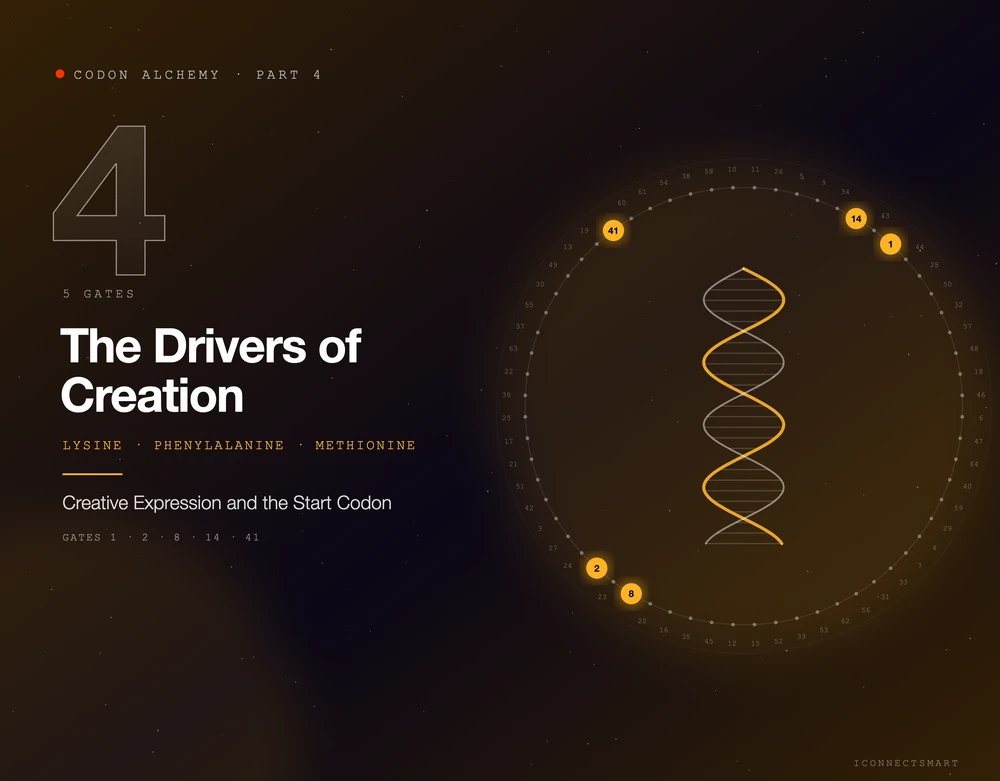
The Drivers of Creation: Lysine, Phenylalanine, and Methionine in Human Design
Nothing you’ve ever made started from comfort. Go back far enough and you’ll find the same thing every time: some version of not-enough, some ache for a feeling you hadn’t had yet, some gap that refused to close on its own. The making came after, and it was always the response.
Most people get this backwards. They wait to feel ready, feel full, feel like they have something worth offering, and then they’ll start. But readiness was never the starting condition. The hunger was.
Methionine and the hunger that starts everything


Start with the plainest version of that hunger, because you’ve felt it more times than you’d probably admit: the sharp, uncomfortable sense that something is missing. It is more specific than vague dissatisfaction, a pressure, the felt absence of an experience you haven’t had yet, sitting in your chest like a question that hasn’t been answered. Treat it as the ignition point of everything that follows, and not as a mood to fix.
The instinct is always to medicate this feeling away, so say it plainly: the hunger doesn’t need to be filled so much as followed. It’s uncomfortable on purpose, because comfort has never once been what pushed a person into anything worth doing.
If you’re sitting with a restless, unnamed ache right now, you’re reading the opening line of whatever comes next.
What makes this particular kind of hunger different from ordinary want is that it doesn’t need anything else to justify itself. It’s not waiting on a plan, a partner, a resource, or permission.
It just starts, on its own, because the discomfort of standing still has finally outweighed the comfort of staying put. Everything that gets built afterward is built on top of this one plain fact: something in you refused to stay satisfied with not-yet.
Phenylalanine and a direction you can’t explain


Once that hunger is moving, it needs somewhere to go, and this is where it gets quieter and considerably harder to explain to anyone who asks you to justify it.
A kind of knowing in you doesn’t arrive through thinking. It’s closer to an alignment you noticed than a plan you made, a sense of trajectory that was already running before you sat down to figure anything out. Ask someone with this kind of knowing why they’re headed the way they’re headed and they’ll often struggle to give you a clean answer, not because they’re confused, but because the answer was never built out of reasoning in the first place.
This deserves more trust than it usually gets, especially from people who pride themselves on having a reason for everything. Some direction in you is never going to show up as a strategy. It’s going to show up as a pull you can feel but not fully argue for, and the temptation to override that pull with something more “logical” is how people end up years into a life that technically makes sense and feels like someone else’s.
If you’ve ever known which way to go before you could explain why, and then talked yourself out of it because you couldn’t defend it in a meeting, go back to that moment. The direction doesn’t need your approval to be correct. It just needs you to stop demanding an explanation before you’ll follow it.
What makes this direction matter beyond your own life is what happens when you walk it instead of arguing with it, because a direction lived all the way through stops being private. Other people watch someone move with real alignment, and something in that example becomes usable to them, whether or not a single word gets exchanged.
You don’t have to announce your direction to contribute it. Living it is the contribution.
One more thing complicates the idea of “pure” individual direction in a useful way: your sense of where you’re headed isn’t entirely self-generated. Some of it comes from what you’ve absorbed, the people you’ve watched, the examples that quietly shaped what felt possible for you long before you consciously chose anything.
Your direction is yours and also, in part, something the world around you helped write. Both things are true at once, and neither one cancels the other.
Lysine, creative force and its fuel


So the hunger sets things moving, and the direction gives the movement somewhere honest to go. What’s still missing is the force that turns any of this into something real instead of staying a private ache with a vague sense of trajectory attached to it.
This is where the tension shows up, and it deserves a direct name instead of pretending it isn’t there: the drive to make something and leave a real mark on the world, sitting right next to the very real anxiety that the vision might outrun the resources available to build it. Anyone who’s ever had a big idea and then hit the wall of funding, staffing, or sustaining it knows this tension intimately. It says nothing about the idea being wrong, because it is the friction this whole process runs on.
The drive itself is about as pure and forceful as anything gets: pure origination, the urge to put something into the world that wasn’t there before, with no interest in waiting for permission first. That force alone can feel almost too hot to hold, restless in a way that makes stillness uncomfortable. It wants to be seen making something, not just thinking about making something.
But force without fuel goes nowhere real. Alongside that raw creative push, there has to be something that converts it into visible form: the practical resources, the material capacity, the plain “gas pedal” energy that takes an ambition and gives it enough traction to move. Without this, creative force just spins, loud and unexpressed, wanting recognition it has no way to earn yet.
If this tension lives in you, the hunger to be seen as powerful and the anxiety that you might not have what it takes to back that vision up are not opposing forces canceling each other out. They’re the same engine, running with both a push and a brake attached, and the discomfort of holding both is what keeps ambition honest instead of letting it run unchecked into fantasy.
Put all three of these together, hunger, direction, and force, and you get something closer to how anything real gets made, whether it’s a piece of work, a relationship, a life.
First comes the ache, the specific, uncomfortable sense that something hasn’t happened yet, refusing to let you stay still. It doesn’t ask permission and it doesn’t wait for you to feel ready. It just starts the whole sequence by making stillness intolerable.
Then comes the pull, a sense of trajectory you didn’t build with logic, shaped partly by what’s innately yours and partly by everything you’ve absorbed from watching others. It gives the raw hunger somewhere honest to travel instead of scattering in every direction at once.
Then comes the force, the raw drive to make the thing, held in tension with the real fear that you don’t have enough behind you to pull it off. If you let it, that tension keeps you building something real instead of something merely imagined.
None of this happens in the order most people assume. Nobody starts with a fully resourced plan and then feels motivated to execute it. It starts with discomfort you didn’t choose, moves through a direction you can feel more than explain, and only becomes visible once you’ve pushed creative force against the friction of having to deliver on it.
If you’re in the middle of that friction right now, hungry for something you can’t yet name, sensing a direction you can’t fully justify, or caught in the gap between what you want to build and what you currently have to build it with, none of that means you’re doing it wrong. That is the process itself, running as it’s built to run.
So which part are you standing in right now: the hunger that hasn’t found its shape yet, the direction you already feel but haven’t trusted out loud, or the force pushing against a resource gap that hasn’t closed? And what would it look like to stop waiting for that discomfort to resolve before you let it move you?
Methionine · Associated Gates: Gate 41 – The Gate of Contraction
Phenylalanine · Associated Gates: Gate 2 – The Gate of Direction of the Self and Gate 8 – The Gate of Contribution
Lysine · Associated Gates: Gate 1 – The Gate of Self-Expression and Gate 14 – The Gate of Power Skills